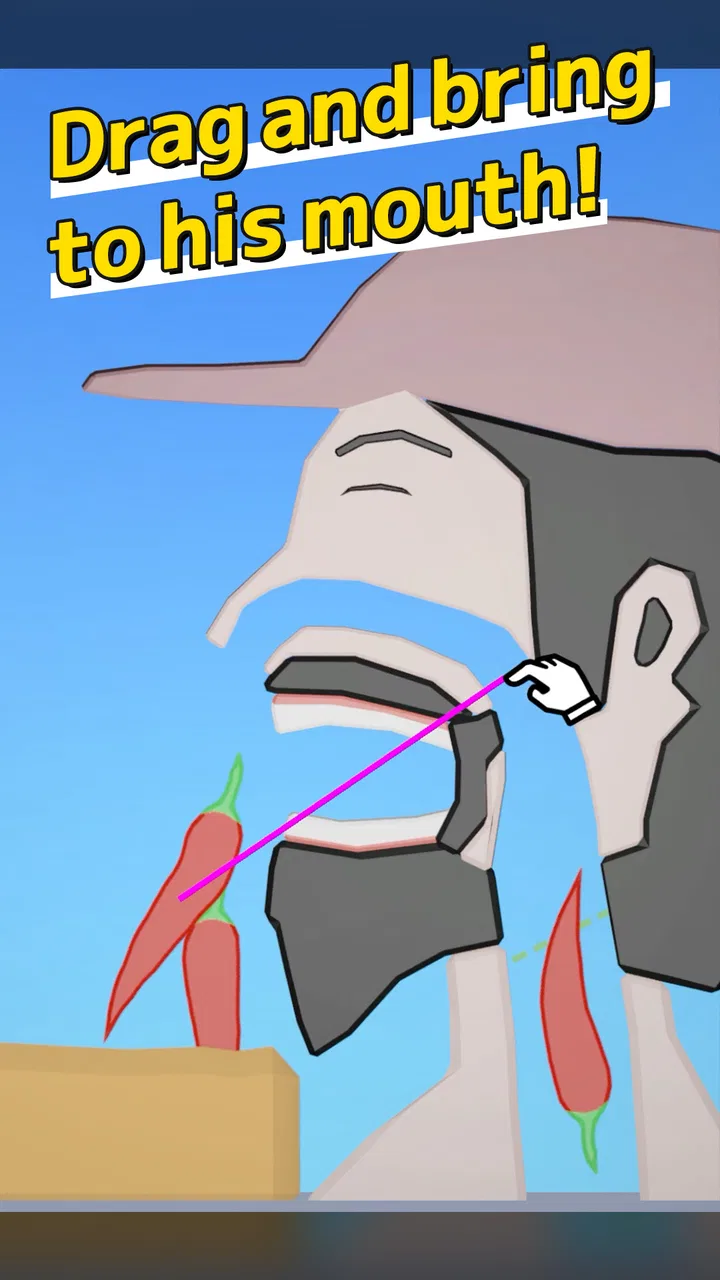
Eating Simulator: Physics Food
- 4.1
- Rating
- 10.00M
- Installs
- Free
- Price

 Analysis by App-foxy
I went into Eating Simulator: Physics Food expecting a tiny joke game and found something more deliberate than its short store summary suggests. The central idea is wonderfully simple: I try to eat. Yet the physics-based presentation turns that basic goal into a sequence of small decisions about timing, positioning, patience, and how much control I really need to use. It is a simulation game from KAYAC Inc., available free of charge, and its appeal comes less from a large world or a long narrative than from making an ordinary action feel oddly entertaining.
The game is best understood as a compact, hands-on toy rather than a traditional life simulator. I am not managing a restaurant, building a character, or following a detailed story. Instead, the pleasure comes from interacting with food through physics and seeing whether a seemingly easy action works as planned. That distinction matters. If you want a substantial progression system, carefully written characters, or a broad collection of activities, this will probably feel too narrow. If you enjoy short experiments with a silly premise and immediate feedback, it has a much better chance of fitting your routine.
How the simple premise creates meaningful decisions
The first useful decision is how seriously to take the objective. “Eating” sounds like a task that should require no thought, but the physical behavior makes every attempt more active than tapping through a menu. I found myself adjusting my approach instead of repeating the same movement blindly. A direct attempt may be quick, while a slower, more controlled action can be safer when the food does not behave exactly as expected.
You May Also Like

 Blood Strike: 2.5 Anniversary
Blood Strike’s Loadouts Turn Every Drop Into a Tactical Gamble
A close look at Blood Strike’s custom loadouts: how fast access to signature weapons reshapes its battle royale rhythm, rewards preparation, and narrows the gap between fights.

 Pandora - Music & Podcasts
Pandora’s Music Is Easy to Start, but Harder to Recover
Pandora’s strength is its low-effort path from a seed to a station. Its weak spot is how much confidence it asks you to place in connection, setup, and quiet recovery.

 8 Ball Pool
 Is Built on Rivalries, Rematches, and Routine
A close look at the rivalries, rematches, shared routines, and unanswered safety questions that turn a quick pool match into a persistent mobile community.

 Samsung Music
’s Quiet Strength Is Playing What You Already Own
Its reach comes less from spectacle than from dependable access to a personal library. That simplicity is both the app’s strongest retention engine and its ceiling.

 AccuWeather: Weather Radar
AccuWeather Review: A Quick, Clear Forecast for Everyday Decisions
For everyday plans, the best forecast is the one you can understand quickly. AccuWeather makes rain timing, radar, and local conditions easy to act on, with a few trade-offs.

 Hill Climb Racing
Why Hill Climb Racing Still Turns Crashes Into One More Run
A tiny car, a bumpy hill and one more upgrade: Hill Climb Racing keeps resurfacing because its simple chaos makes every near-miss feel personal.
More From Our News Desk



That gives the game a pleasant miniature decision space. I am constantly judging whether to act now, reposition, or try to recover from an awkward result. These choices are small, but they are visible and immediate. The game does not need a complicated rulebook to make me think; the object’s movement and the timing of the interaction communicate what went wrong.
The important skill is not speed alone; it is learning when control is worth more than momentum. A rushed attempt can look efficient, but if it creates a bad angle or sends the food somewhere inconvenient, the saved second means very little. On the other hand, excessive caution can make a simple challenge feel unnecessarily slow. The satisfying middle ground is to make a quick plan, test it, and change course as soon as the physical response tells me that the plan is poor.
This also makes the game approachable for people who do not normally play simulation titles. There are no complicated economic menus or long-term management screens to learn before the core interaction becomes enjoyable. I can start experimenting almost immediately. The trade-off is that the same simplicity limits the range of decisions available. Once I understand the basic interaction, the game depends heavily on whether I enjoy refining small actions for their own sake.
In everyday use, I can imagine opening it while waiting for a coffee, taking a few attempts, and closing it without feeling that I have abandoned a larger commitment. It suits short sessions better than games that expect me to remember a complicated objective after a busy day. That convenience is one of its strongest practical qualities, especially for players who want a playful distraction rather than another demanding hobby.
Planning each attempt instead of treating it as random
The physics can initially make outcomes feel unpredictable, but I would not treat that as pure randomness. The better approach is to observe the starting position and decide what kind of movement gives the food the best chance of ending where I need it. I began to think in stages: first establish control, then create a useful angle, and only then commit to the final action.
This staged approach is more reliable than making a dramatic movement immediately. It also gives me a way to diagnose mistakes. If the food moves badly at the beginning, the problem may be the initial position rather than the final action. If the setup looks good but the result fails, timing or overcorrection may be responsible. That distinction helps the game feel like a small physics puzzle instead of a sequence of arbitrary failures.
A practical tip is to make the first attempt exploratory. I use it to learn how responsive the interaction feels and how much movement is too much. After that, I can repeat the successful portion rather than improvising from the beginning every time. This is especially useful when I am playing with one hand or on a smaller screen, where precision can be less comfortable than it is during a focused session.
Another useful habit is to avoid correcting every tiny movement. Physics-based objects often settle more naturally when I give them a moment instead of constantly fighting their motion. Overcontrol is a real source of frustration here: I may think I am fixing a problem while actually introducing a second one. The game rewards a light touch more than frantic input.
Where the risk becomes entertaining
The risk-and-reward structure is modest, but it is clear. A bold action may solve the situation quickly, while a careful action reduces the chance of an embarrassing miss. Because the premise is so small, failure does not feel devastating. That encourages experimentation. I can try a more aggressive solution, see how the physics respond, and use the result to shape the next attempt.
I like that the game makes mistakes readable rather than turning them into a heavy punishment. When an attempt goes wrong, I usually understand that my timing, angle, or level of force was questionable. That creates a useful feedback loop: attempt, observe, adjust. It is a better fit for casual play than a system that makes every error expensive or forces me through a long reset process.
Still, the low-stakes design may not satisfy players who need a strong sense of danger. The pleasure is in the interaction itself, not in protecting a carefully developed character or preserving a valuable run. Someone looking for intense survival pressure, competitive ranking, or a deep resource economy should choose a different type of simulation game. This one offers playful risk, not serious consequence.
The best way to enjoy it is to set a personal objective. I might aim to finish an interaction with fewer corrections, find a smoother method, or simply see whether an unusual approach works. Without that self-imposed goal, the experience can become repetitive sooner. With one, the same compact mechanics offer more room for personal improvement than the first few minutes suggest.
Adapting to physics rather than forcing a fixed method
One of the game’s more valuable lessons is that a method that works once is not automatically the best method forever. Small changes in position or timing can make a familiar action behave differently. I therefore get more from it when I react to what is on screen instead of memorizing one gesture and repeating it mechanically.
This is where the simulation label feels appropriate. I am not simply selecting a command from a list; I am interacting with a physical situation and adapting to its response. That makes observation part of the play. Before acting, I look at the available space, the object’s orientation, and the likely direction of movement. During the attempt, I watch for signs that the plan is drifting and decide whether to intervene or let the motion continue.
There is a useful trade-off between consistency and discovery. A repeatable technique is valuable when I want a dependable result, but trying unfamiliar approaches keeps the game from becoming a routine. I recommend alternating between the two: first establish a comfortable method, then deliberately test one variable at a time. Change the timing, not everything at once. That makes it easier to understand which adjustment helped.
This approach also answers a common concern about physics games: whether success is mainly luck. In my experience, the more I paid attention to setup and timing, the less arbitrary the results felt. There can still be awkward moments, and the physical behavior is part of the charm, but careful observation gives me meaningful influence over the outcome. Players who dislike any looseness in controls may remain impatient, while players who enjoy tactile experimentation will probably accept it as the point.
The game is also a reasonable choice for sharing with someone nearby. I can hand over the device and let another person try to solve the same situation, then compare approaches. That kind of informal challenge works because the premise is immediately understandable. Nobody needs a long explanation before making an attempt. It is not a full multiplayer experience, but it can still create a small social moment through turn-taking and experimentation.
What remains interesting after the novelty fades
The long-term question is not whether the premise is funny once; it is whether the interaction remains enjoyable after I understand it. The answer depends strongly on my relationship with repetition. The game does not present itself as a broad simulation with many unrelated systems. Its depth comes from improving execution, noticing physical details, and finding satisfaction in cleaner solutions.
That gives it a particular planning horizon. In the immediate horizon, I am solving the current eating situation. Over several sessions, I am learning which movements are reliable and which create unnecessary trouble. Beyond that, the game’s appeal becomes personal: can I keep inventing small challenges for myself, or do I need a larger progression structure to stay motivated?
I would not recommend expecting a conventional campaign. This is better approached as a pocket-sized activity that I revisit when I want a quick, unusual interaction. The free price makes that low-commitment format easier to accept, but free access does not change the central limitation: a narrow concept will eventually feel narrow to players who want constant novelty.
Its audience size suggests that the idea has reached a substantial Android audience, with over ten million installs and an average rating of four out of five from around twenty-three thousand ratings. Those figures do not guarantee that it will suit everyone, but they do match my impression that the game is easy to understand and broadly accessible. It has also accumulated hundreds of written reviews, which is consistent with a title people can react to quickly, whether they enjoy the physics or find the repetition too slight.
On Android, it requires version six or later, so it is not aimed only at the newest devices. The current version is 0.3.7, and the age rating is Teen. I would still use ordinary judgment when deciding whether it is appropriate for a younger player, particularly because the rating is part of the game’s official presentation and not a substitute for a parent’s own decision.
Who should play it, and who should skip it
I think it is a good match for players who enjoy experimental physics, short simulation sessions, and humorous concepts that become engaging through interaction. It is especially suitable if you like watching a plan almost work, correcting it, and trying again without a severe penalty. It can also serve as a palate cleanser between larger games: something with enough control to occupy my attention but not enough obligation to demand an evening.
I would be more cautious about recommending it to someone who needs a clear story, a large upgrade tree, or a strong sense of permanent progress. It is also not the best choice for players who become annoyed when physical objects do not respond with perfectly rigid precision. In those cases, a conventional puzzle game with fixed solutions may feel fairer, while a management simulator may provide more meaningful long-term planning.
Compared with other casual simulation games, this one trades breadth for immediacy. A restaurant simulator gives me menus, staffing, money, and expansion decisions. A life simulator offers relationships, schedules, and a broader routine. A physics puzzle usually gives me more formal problem-solving structure. Eating Simulator: Physics Food sits apart by reducing the fantasy to one physical action and asking whether that action alone can carry the experience.
That comparison clarifies its value. It is not trying to replace a full simulation game; it is a compact alternative for a different mood. I would choose it when I want tactile amusement and quick experimentation. I would choose another game when I want strategic planning across many systems, a narrative reason to continue, or a clear sequence of increasingly complex objectives.
My verdict after looking past the joke
Eating Simulator: Physics Food works because it understands the strength of a focused idea. The goal is funny, but the physics give it enough uncertainty to create decisions. I have to plan an approach, judge whether to take a risk, and adapt when the object refuses to behave exactly as expected. Those choices are small, yet they are concrete enough to make the game more than a one-line gag.
My main advice is to play it as a light simulation toy, not as a full-scale progression game. Give yourself small goals, use early attempts to study the interaction, and resist the urge to overcorrect every movement. That mindset brings out its best qualities and reduces the frustration caused by treating every result as something that should be perfectly predictable.
For a free game from KAYAC Inc. with a simple premise and a Teen content rating, it offers a surprisingly distinct kind of casual entertainment. I would recommend it to a friend who likes physics-based experiments and wants something easy to pick up. I would skip it for a friend asking for deep systems or a long-term campaign. Its strength is not how much it contains, but how much personality it finds in one carefully focused action.
FAQs for Eating Simulator: Physics Food
01What is Eating Simulator: Physics Food all about?
Eating Simulator: Physics Food is a quirky and entertaining simulation game where players experience the unique challenge of consuming various food items using realistic physics mechanics. The objective is to eat as much as possible while navigating obstacles and challenges. Its humorous approach and engaging gameplay make it a fun choice for all ages.
02What platforms is Eating Simulator: Physics Food available on?
Eating Simulator: Physics Food is available for both Android and iOS devices. Players can download it from the Google Play Store or the Apple App Store. Ensure your device meets the required specifications for optimal performance and a smooth gaming experience.
03Are there any in-app purchases in Eating Simulator: Physics Food?
Yes, Eating Simulator: Physics Food offers in-app purchases. While the game is free to download and play, certain items and features can be purchased to enhance gameplay. These purchases are optional and not necessary to enjoy the core elements of the game.
04How does the game ensure player engagement and fun?
The game uses a combination of humorous scenarios, a variety of food items, and challenging physics-based puzzles to keep players engaged. Regular updates introduce new levels and features, ensuring fresh content and extended playability. The whimsical art style and sound effects add to the overall entertainment value.
05Is Eating Simulator: Physics Food suitable for all ages?
Eating Simulator: Physics Food is designed to be family-friendly and is suitable for all ages. The game’s simple mechanics and comedic elements appeal to both kids and adults. However, parents might want to supervise younger children to ensure they understand the in-app purchase aspect of the game.
Pros
- Engaging and fun physics-based gameplay.
- Wide variety of food items to interact with.
- Colorful and appealing graphics.
- Easy to pick up and play for all ages.
- Frequent updates with new content.
Cons
- Can become repetitive over time.
- Advertisements can interrupt gameplay.
- Minor bugs affect smoothness occasionally.
- Limited multiplayer interaction options.
- Requires stable internet connection for features.

Eating Simulator: Physics Food
Gallery